Saturday, 18 January 2014

Controversial Content In YA novels


Contemporary fiction for teenagers is much more controversial than when I was a child. Dark subjects such as suicide, incest, rape and brutality are now featured in many novels directed at children from ages 12 years and up. If books show us the world, teen fiction can reflect portrayals of what contemporary life is and how it is also portrayed in the media and in movies. Young readers often find themselves surrounded by images not of joy or beauty but of damage, brutality and losses of the most horrendous kinds. So what responsibility, if any, does an author have when it comes to depicting controversial content?

I am guilty of writing about dark subjects in my YA novels: The Last Refuge (domestic violence), Crossing the Line (self-mutilation and stalking), and The Girl in the Basement (kidnapping and murder). I didn’t set out to write controversial subject matter; what I’ve written in these books, and what I write in most of my social-realism novels generally comes from my own life experience or my observations of and reflections on what is happening about me in the society in which I live.

The Last Refuge, about children who are witnesses to domestic violence, comes from my childhood experience. I wasn’t just a witness; I was physically assaulted by my father, as were my siblings and my mother. I didn’t know as a young person that others suffered like this, too, at the hands of family members. If I had read The Last Refuge as a teenager, I would have known ours was not the only family which suffered. And, too, I would  have found out that there were refuges to which women and their children could flee to (something else I didn’t know).
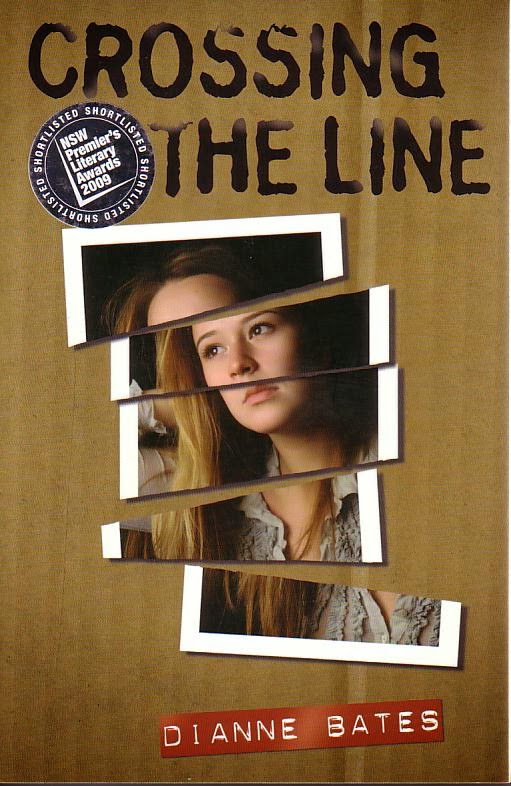
I was also unaware that other confused and damaged young people cut themselves, as I did as a teenager and as Sophie does in Crossing the Line. In writing this novel, I also drew on my experiences as a person with a mental illness (I have bipolar disorder). This gave authenticity to scenes inside a psychiatric hospital ward and dealings with staff, in particular with a psychiatrist who metaphorically crossed the doctor-patient line. Was the book a catharsis? I’d be lying if I said it wasn’t. But I’m also aware that when a book comes from the author’s own experience, it has a genuine authenticity that an astute reader can pick up on. When the book was released, I was inundated by adults who told me that they had self-mutilated as teenagers, and when I spoke to teenagers in high schools invariably there were girls who admitted knowing peers who did this, too. I had a few letters/emails from teenage girls who confided in me their self-harming, and so I was able to offer them comfort and advice.

Incidentally, my husband, Bill Condon, who is a prize-winning YA author, had a long correspondence with a teenage girl who wrote to tell him about losing her virginity, something she hadn’t even told any of her friends or family. She was responding to the emotional truth in one of his novels, Dare Devils.

My third YA novel, The Girl in the Basement, was coincidentally released the same week that the three young women escaped from their long-term captivity in a house in Cleveland Ohio at the hands of a perverted monster. This book’s genesis came from a newspaper clipping I’d kept for years about a teenage girl and a seven-year old boy who had disappeared from their respective homes some months before a Polaroid photo of the two, bound and gagged, was discovered in a Florida car-park. Though my circumstances were different, as a child I knew what it was like to be held prisoner to a madman father so I was able to draw on those experiences. (And I knew how it feels to want to murder someone!)

Whether you care if adolescents spend their time immersed in ugliness or in beauty that is in books probably depends on your philosophical outlook. My take is that reading about homicide doesn't turn a person into a murderer; reading about cheating on exams won't make a kid go ahead and do this; no teenager is going to take up smoking because a character in a book smokes, and so on. Today’s teenagers are a part of a society in which bad things happen. They see it first-hand in day-to-day life; they watch it on television; they read about it in magazines and in newspapers.  How they grow and develop is not dependent on any single book they read, but it is a combination of factors, not the least of which is the effect of the moral environment in which they are raised. Parents have far more influence in steering a child’s passage into adulthood than any other single factor.

Fifty years ago when I was a teenager, no-one had to contend with young-adult literature because there was no such thing. There was simply literature, some of it accessible to young readers and some not. Since the 1960s books have been published that deal directly with subjects such as family dysfunction, disaffected youth, drug abuse, alcoholism and so forth. Society has changed and those who practice in the creative arts reflect this in their works. We cannot present life as being candy-coated when it’s not. What I hope to do as a responsible author is to show how my fictional characters cope with darkness in their lives and how they can emerge with solutions, and ultimately with hope for a better life outcome.


Sunday, 15 December 2013

YA NOVEL: KATE

Kate is a recently released YA novel by Australian Kevin Burgemeestre about growth and mistakes. 

Kate is struggling to deal with her best friend leaving, a school bully and with the death of her mother. She believes that life is hard. Then a chance encounter with a battered, heroic hound she rescues from the streets, and Mal, a troubled young man with a dark past, leads Kate into more danger and excitement than she could have wished for.

She wonders about her unusual friendship with this damaged young man, but when things go really wrong, they’ll need each other ... and they’ll have to run!

ABOUT THE AUTHOR

Kevin is no stranger to readers. As an artist and illustrator with more than 25 years’ experience, he has a list of over 60 published books that contain his illustrations. Kate contains five illustrations which were exhibited at the Stonnington Literature Alive exhibition earlier in 2013.

Kevin has recently turned his hand to writing. Kate, his debut novel, was completed as part of the Copyright Agency residency at the University of New England in 2012.

Based in Melbourne, Australia, Kevin is well known for enthusiastic, informative and humorous approach to workshops with children and adults, as a children’s book illustrator, editorial writer and an illustration lecturer. Kevin is available for book signings and workshops.

ISBN:             978-0-9875434-4-8  

FORMAT:     Paperback – eBook coming soon.

EXTENT:        Pages: 200

                       Paperback: $22.00

PUBLISHER:  Morris Publishing Australia

PUB DATE:    November 2013

CATEGORY: Fiction

AUDIENCE:  Teen - Young Adult  

WHOLESALE AND RETAIL ORDERS:

Morris Publishing Australia - http://www.morrispublishingaustralia.com

Dennis Jones and Associates: www.dennisjones.com.au

James Bennett library suppliers: www.bennett.com.au

The Nile Bookshop: www.thenile.com.au     


BLOG TOUR

Tuesday 3rd Dec - 10  writing tips http://deescribewriting.wordpress.com

Wednesday 4th Dec - Interview
http://www.buzzwordsmagazine.com

Thursday 5th Dec - Interview
http://www.alisonreynolds.com.au

Friday 6th - article
http://sherylgwyther.wordpress.com

Saturday 7th Interview
http://bookmusterdownunder.blogspot.com.au

Sunday 8th Dec
www.jackiehoskingpio.wordpress.com

Monday 9th Interview
http://www.kidsbookreview.com

Monday 9th Interview
http://UncommonYA.com

Tuesday 10th Review
http://www.melissawray.blogspot.com.au

Wednesday 11th Review
www.karentyrrell.com

Thursday 12th Interview
http://www.sallymurphy.blogspot.com

Friday 13th Interview
http://lorrainemarwoodwordsintowriting.blogspot.com

Saturday 14th Article
http://clancytucker.blogspot.com.au

Sunday 15th Dec Interview
http://www.morrispublishingaustralia.com/news-update-blog.html

Monday 16th Dec Interview
http://diannedibates.blogspot.com.au

Tuesday 17th Dec Interview
http://elaineoustonauthor.com.au


Thursday, 12 December 2013

Meet my main character


When you have published over 120 books as I have -- most of which are novels for young readers -- you have made the acquaintance of many protagonists over the years. Most of my main characters are based on or composites of real life people I’m acquainted with, including myself. I’m sure most authors incorporate their own experiences and emotions in their book characters, even when they are writing fantasy, sci fi or horror. The main genre of my novels (and the type of novel I most prefer to read) is social realism.

When I am about to start writing a new novel, I spend much time thinking and writing notes about characters and storyline. But first and foremost for me is character. It is a character with a problem or in a particular situation who decides the direction of the plot. Characters I’ve employed are Libby Bramble in my latest cross-over novel The Girl in the Basement (Morris Publishing Australia), a typical cheerful, enterprising girl who is kidnapped on the night of her sixteenth birthday by a serial killer. The story follows her capture, her captivity and her developing relationship with the man she calls Psycho Man from whom she attempts to escape.

In my latest (unpublished) book, an adult novel, The Freshest of Flesh, there are two protagonists who narrate their stories in alternating chapters: Dovey, a woman serial killer who hunts paedophiles, and Ray, recently released from prison who is battling his sexual proclivity for young girls. I really enjoyed writing this book but when I had it assessed recently by a freelance editor, I was appalled by her unfavourable reaction to it (mostly because of my portrayal of the paedophile whose thoughts she felt were too unsavoury for a general readership). So much for realism! Notwithstanding numerous pages of critical comment, I will re-write the book, taking the editor’s comments into consideration. Incidentally, over the past 30+ years I’ve been writing I still attend a weekly writing critique group which I find essential for improving my stories and for keeping me motivated -- highly recommended, especially for new writers.

My first novel, Terri, published in 1980 by Penguin, had as its main character a ten-year-old girl I met when I lived on a mountain in southern NSW, Australia. What most intrigued me about ‘Terri’ was her lifestyle. Her parents were divorced so she was shared between them, living for six months of the year with her mother in Melbourne and the other half of the year with her father, a well known stage and film actor who adopted a hippy lifestyle when Terri went to live with him on Dr George Mountain where I was his neighbour. I didn’t know all of the details of Terri’s story so I invented a story that fitted into her life scenario.

The main character of my second book Piggy Moss (Puffin), was based on my own experiences as a child living on a pig and poultry farm. I had always suspected there was a family secret and this was confirmed when my parents announced when I was ten that I had a half-brother, Jack, who was coming from England to live with us. Voila, I had a story I just needed to follow.

The only fantasy novel I’ve authored was my third book, The Belligrumble Bigfoot (Kangaroo Books) which followed the story of a mythical creature said to inhabit an outback town. The protagonist of this book was pure invention, a neurotic boy, Willie Macbeth, who has a powerful imagination that allows him to escape into fantasy when there are sightings of the creator. Willie mentally transforms himself into powerful characters who battle with and overcome the bigfoot.

One of the most difficult books I’ve written – and which won a Children’s Book Council of Australia (CBCA) Notable award – was The Shape (Allen and Unwin). This book was deeply personal for me and took a long time to write as it was based on the death of my second child, Kathleen Julia, at the age of two. Years after Kathleen’s death, her sister Claire told me that for a long time afterwards, she would lie awake at night looking at a shadow on her bedroom wall; she believed it was this ‘shape’ which was responsible for killing Kathleen – that it had ‘eaten’ her. Claire was four at the time of her sister’s death; she never told me about the shadow until she was a teenager. I felt so sad for her and wished she had told me at the time so that I could have explained death to her more clearly than I obviously had.

More recently my first verse novel, Nobody’s Boy (Celapene Press), also won a CBCA Notable Award. This book is based on the character and story of Paul, a nine-year-old boy whom my husband (award-winning YA author Bill Condon) and I fostered for three years. The story is faithful to Paul’s experiences, including how at the age of six he saved the life of his mother, a drug addict, and the life he led until and including the time he came to Bill’s and my life. Paul, now aged 22 years and a father, thought the book ‘amazing’.

My next book, a junior novel, A Game of Keeps (Celapene Press), due out mid-2014, is loosely based on a child Bill and I fostered for some years. Her drug- addicted mother often left Ashley alone for long periods; like Paul, she was a resourceful, cheerful child whom we loved. Happily, Ashley’s mother was able to overcome her addiction and presented Ashley with a baby brother whom she came to love, though at first being resistant to the idea of a sibling.

There have, of course, been many other protagonists in my books that I could write about, but hopefully I’ve been able to present a general idea of where my characters come from. One of the saddest things about finishing a book is closing the chapter on a book’s protagonist whom I’ve come to identify and care about so much. But then there is the next book to develop and a new protagonist to create and to ‘live’ with until the words The End are written.

 © Dianne Bates

Wednesday, 27 November 2013

AN INTERVIEW WITH ELIZABETH KLEIN


Today I interview Australian children's author, Elizabeth Klein, whose first book in series, Firelight of Heaven, was recently released. Book two, Green Heart of the Forest will be out in early 2014.
1. Can you tell us a little about yourself?

I’m a daughter of refugees who fled the Russian invasion of Hungary in the fifties. I grew up in a small village with three brothers. We were quite poor. One day, someone brought us a box of comics. I wanted to read them so badly, I taught myself to read. I loved writing from an early age and spent all my time at the local library. I became a teacher and taught for 19 years, then left and became a tutor and writer of fantasy books. I live with my husband in Sydney.

2. When you were a child did you have a favourite book or books?

As a child, I was drawn to classical adventures such as Coral Island by R.M Ballantyne, Kidnapped by R. L. Stevenson. I also grew to love science fiction novels back then, but I can’t recall any that I read apart from those written by Ursula le Guin. There were also aspects of fantasy that I loved as a child, too.

3. Do you have a favourite genre to both read and write?

It has to be fantasy.

4. Did you have favourite authors growing up who have influenced you?

I definitely loved the classical authors whose writings are beautifully crafted. Lucy Maud Montgomery, Robert Louis Stevenson, Ballantyne and Daphne Du Maurier were just a few.

5. When did you know you wanted to be an author?

Early in life. I loved writing stories in Primary and I wrote my first book back then. It was quite a good science fiction story about a boy who discovers that he’s not human. Anyway, I thought it was good.

6. How did you go about becoming an author?

Lots of hard work, persistence and prayers. I joined my local FAW and also a small writers’ group where the veterans put my writing in its place. I learnt about show, not tell and many other aspects of writing about which I had no idea. I admired these old time writers and wanted my writing to shine like theirs did. I started to enter competitions and wrote for Viatouch, an educational online site that accepted lots of my articles and lessons. Then I had the wonderful Annie Hamilton mentor me for a week and I learnt so much from her. When I felt my manuscript was finally ready for publication, I sent it to Rochelle at Wombat Books, who accepted the first two books in my series.

7. If you weren’t a writer, what would you like to be?

I have no idea. I’ve never contemplated a life not writing. To me, writing is the best vocation. Perhaps a movie director might be something I’d consider as I love directing plays.

8. Beside reading and writing, what do you like to do?

This is probably a bit boring, but since I have hardly any time to sit and watch anything, I really love seeing a good movie such as Oblivion or After Earth or Narnia. I also love grabbing some take-away and going and sitting beside the sea with my neglected husband. We watch the waves, the dolphins and occasionally whales spouting in the blue. And no computers.

9. Do you have a place you love to visit or would love to visit?

One of the places I’d love to visit is Middle Earth, New Zealand and Britain.

10. If you could have a meal with three living people, who would you choose and why?

Just having dinner with my three best friends and having a normal conversation (not about writing).

Finally, can you tell us about your current books and/or any that will be coming out soon.

My debut book, Firelight of Heaven, will be out on 1 October, 2013. It’s a fantasy adventure involving two brothers and an elf girl seeking the lost crystals of the Morning Star and the boys’ missing parents. Their journey leads them into one of the perilous lost lands which is guarded by Queen Shara and her countless children. Very scary.

Book two, Green Heart of the Forest, will be out early next year and involves a mysterious elemental woman seeking her home tree in a dangerous community of cut-throats and pick-pockets. Book Three, Ice Breath of the Earth, hasn’t been offered yet to my publisher. I’m just finishing book four, Crown of Shadows. When it’s completed, I might work up courage and offer them both.  

Where can readers find you on the web?

www.bethloria.com.au

Thanks again for your time and agreeing to be on my blog

Wednesday, 13 November 2013

AN AUSSIE YEAR: TWELVE MONTHS IN THE LIFE OF AUSTRALIAN KIDS


An Aussie Year: Twelve Months in the Life of Australian Kids by Tania McCartney, illustrated by Tina Snerling (Exisle Publishing, 2013)

Reviewed by Dianne Bates

The author, illustrator and publisher ought to be very proud of this beaut book. The bright, well-designed cover shows Australian children – Zoe, Kirra, Matilda, Lily and Ned – of different ethnic origins who each has childhood adventures throughout the following pages.

Next to come are the fly pages: Wow, what a lovely introduction to what is to follow! They depict dozens of colourful, fascinating boxed illustrations of the five children enjoying their Aussie lives. After this, the children are introduced. Kirra, for instance, is an Aboriginal boy who wants to be an environmental scientist when he grows up. Matilda – whom everyone calls Tilly – was born in Ireland; she loves sewing and horse riding. Each of the children has a history, hobbies and an ambition.

From then on the book’s double pages tell what happens to each of these children during each month of the year. In January, for example, they play cricket, enjoy picnics, eat icy poles, swim during the school holidays and celebrate Australia Day. (Lily, whose father is Vietnamese, enjoys Tet, or Vietnamese New Year, which sometimes falls in February). In April there’s Anzac Day, the Royal Easter Show, the Easter Bilby and April Fool’s Day, and so it goes on.

As young readers turn the twelve double pages, they can relate to the various activities and events that the book’s characters engage in and enjoy. Each page is beautifully designed with lots of white space, lively variations of text and colourful cartoonish illustrations. After each of the months’ page-spreads, there’s a map of Australia with interesting and relevant facts: Zoe swims in the Great Barrier Reef, Ned surfs off the West Australian coast, Kirra fishes near Kakadu, Matilda builds a snowman in Tasmania in winter and Lily announces there are six states and two territories in Australia.

This is a truly delightful book that not only celebrates friendships and all that Australia has to offer, but which will reward young readers (and older ones, like this reviewer) with many hours of enjoyment. Writers for children are told not to preach to their readers, or try to teach lessons: any child opening An Aussie Year will not realise that there is indeed lots to learn from perusing this book; they’ll be having too much fun reading it and looking at the terrific pictures!

Sunday, 3 November 2013

BAILEY BEATS THE BLAH

Bailey Beats the Blah
A new book for children by Karen Tyrrell illustrated by Aaron Pocock

Bailey hates his new school. His tummy aches. He has no friends.

His dog Fuzzy slobbers all over him. BLAH!

How can Bailey change his BLAH to HA-HA-HA?

Bailey Beats the Blah is an empowering picture book to help kids overcome sad days and worry thoughts. This emotive narrative boosts self-esteem, emotional awareness and action plans on how to lift a child’s mood. 


Bailey is aligned with Kids Matter program on the National Education Curriculum and supported by counselling service, Kids Help Line.

ISBN: 9780987274045

FREE children's activities and FREE teacher notes are available on www.karentyrrell.com


Bailey Blog Tour & Book Giveaway


Bailey Beats the Blah Book Giveaway
Help Stamp out the BLAH!
WIN:  Copies of Bailey Beats the Blah, a signed Bailey artwork by illustrator Aaron Pocock and a picture book assessment with chief editor at Book Cover CafĂ©.
Leave a comment on any of the 16 hops on the Bailey Beats the Blah tour Nov 3rd -18th. The more comments you leave the MORE chances to WIN.
WINNERS announced on Nov 20th at www. karentyrrell.com


Saturday, 2 November 2013

BEWARE OF BACK STORY


Have you ever read a first chapter that took your breath away? Made you cry? Shocked you? If you can accomplish an emotional reaction in your reader that quickly — hopefully by a quick attachment to your protagonist — half your battle is won. When you think of all you have to accomplish in the first few pages of a novel, you really understand how writing a great first scene requires many hours of practice, and concentration. It takes examining successful, long-lasting novels to see how that first scene was constructed.

Without sending you into cardiac arrest by listing nearly twenty important items you need in that first scene, I’m going to concentrate on some important ones — the ones that really need to be considered. Some of them are essential “do not’s.” And the first one you may already know (but often feel so tempted to fall back on): No back story.

Briefly, back story is narrative explanation -- all the information you as the author know about your characters: their histories, where they came from, who they’re related to, how they came to be where they are now. In other words, information that belongs in your characters’ past.

In order to start your story with a punch and draw your reader in, you need to construct a scene with action happening right here and now. Some writing teachers say things like “no back story in the first fifty pages.” Some editors will be so bold as to say they would be happy if they saw NONE in the entire book. Maybe that won’t quite work for your book, but it’s sad to say that countless opening scenes start with a line or two in the present, and then, whoosh! There you are reading about the character’s early life or marriage or something she did right before the scene started. Which should make you ask…Are you really starting your story in the right place?

More often than not, the answer is no. That’s what second and third drafts are for — throwing out your first scene or two. As a manuscript assessor, I find that a good number of novel submissions I read should really be starting with chapter three or four. A lot of beginner writers spend one, two, ten or more pages just “setting up” the story by explaining a mountain of information they think the reader must have before the story can actually get underway. Kids want action in their stories! Not boring back story.

A helpful exercise to remove back story is for you to go through the first thirty pages of your novel and remove every single instance where you’ve used back story or informative narration, and then chose only three brief sentences containing a “back story fact” that you feel you really must include in the opening chapters so the reader would “get” the story. These three sentences can be conveyed by the protagonist in dialogue to another character (forcing you to avoid narrative and share back story via dialogue, which is usually the best way to do so).

Needless to say, when you re-read your story, you will surely agree that your novel reads much better without the back story. So think about weaning yourself off the need to explain. Your readers aren’t dumb—really! They don’t need you to explain everything, and they actually enjoy a mystery and being allowed to start figuring out the puzzle you are presenting.

Many books I read and edit don’t “get going” until page ten. All that up-front explaining, narrative, setting up the scene, etc., was all great back in Dickens’s time (A Tale of Two Cities, for example). But we don’t do that anymore. TV, movies, and video games have changed the modern reader’s tastes and readers -- kids in particular -- want cinematic writing.

Sol Stein in his book Stein on Writing says, “Twentieth-century readers, transformed by film and TV, are used to seeing stories. The reading experience for a twentieth-century reader is increasingly visual. The story is happening in front of his eyes.” This is, of course, even more true in the twenty-first century.

So how do you avoid the dreaded info dump and back story?

Think about the emotion, feeling, or sensation you want to evoke in your reader. You want to put them in a mood right away. You want to be specific to generate that mood, which means bringing in all the senses and showing your character in the middle of a situation, right off the bat.

And that’s the next essential element: establishing immediately the drives, desires, needs, fears, frustrations of your protagonist. Not only do you need to show her in conflict, in the midst of an inciting incident, but you need to reveal her heart, hint at her spiritual need, show her vulnerability, and what obstacles are standing in her way. In the first scene? Oh yes. Yes!

Now, go through your first scene and take out all the back story. If needed, come up with only one or two lines that tell a little important information you think the reader must know and use those in dialogue, if possible. Then read your scene over and see how much better it is. Because it will be better. Much better!